The Slowest Money I Make.
Land, knockdowns, and why my favorite deals take two years.
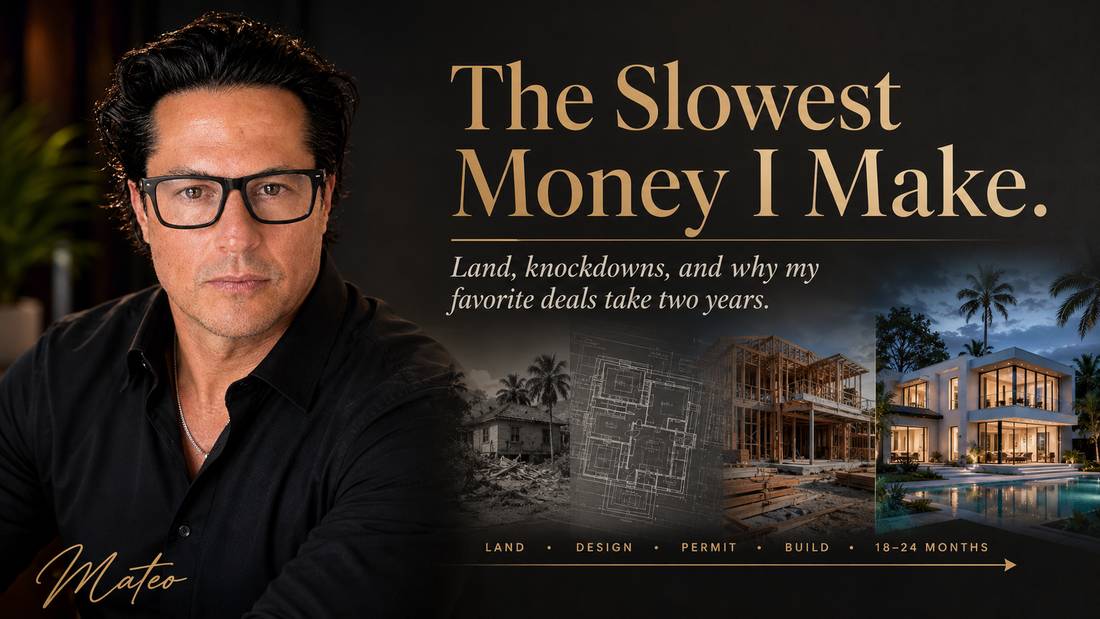
I’ve been putting real estate deals together since the spring of 2000, and the development deals are the slowest money in my life. Here’s the shape of one. I find a lot with a house on it that’s ready to come down, in a neighborhood I know, and I negotiate the deal, close it, and set up the structure, with the attorneys and the accountants and the brokers and whoever else the deal needs. Then comes the long middle, architects and designers, engineers and the city, until the permit is finally in hand, and then we build the right house for that street, the right design, the right finishes and features, with the right team. Eighteen to twenty four months, start to finish, and the whole thing gets won or lost at the two ends, in how it was negotiated on the way in and on the way out.
There’s a name for what this kind of deal is doing, forced appreciation. I’m not waiting around hoping the market lifts the value. The value gets built on the lot, decision by decision, and my favorite part is that I can run the math before we ever break ground. What the land costs, what the build costs, what finished homes on those streets actually sell for. If the numbers don’t work on paper first, there is no deal. Nothing about it runs on hype.
Two years is a long time in a world where a coin can double in a week, and I feel that pull too. But the pull is exactly why I like the slow version. Nothing about a build gets decided by a crowd. The value comes from work you can see, a design, a foundation, finishes a family will actually live with, and when it sells, the person buying it isn’t hoping for a next buyer. They’re moving in.
And this can absolutely go wrong, I want that said plainly. Builds run long. Costs move while you’re building. The market can cool in month nineteen of a deal that was penciled in month one. The protection isn’t at the end, it’s at the beginning and the middle. If the land was bought right, there’s room to be wrong about plenty else, and if the build runs on budget and on time, the margin that was negotiated going in actually survives to the end.
Here’s why I’m telling you about houses you’ll probably never build. Everybody’s money is sitting somewhere on the line between fast and slow, and the fast end is louder. Slow money doesn’t photograph well. It’s a lot of unexciting months in a row. But it’s where the value that holds gets made, in businesses and in careers and in ground, and what you give up in speed, you get back in something you can actually stand on.
On Tuesday I’ll get into what this looks like if you’re never going to pour a foundation, because you don’t need to build houses to put your money on the slow side.
Talk Tuesday.
— Mateo
Mateo Dellovo is also affiliated with real estate development and private investment businesses, including CopperForge Development, CopperForge Capital and Gulfstream Global Partners. These affiliations can present conflicts of interest. Nothing on this site is an offer or solicitation of any security, including an interest in any private fund. These conflicts are described in BFA Wealth Management, LLC’s Form ADV, available at adviserinfo.sec.gov.
If a decision like this is sitting in front of you, the Checkup is free, and it’s a fit call, not a pitch.
Book a 15-minute checkup